Law Enforcement Officers Admit They Want to Track You... ⬎
So Why Do They Keep Lying in Public About What These AI Powered ALPRS Actually Do?
It feels like almost every day a new law enforcement officer in Florida is getting up in front of a podium at a press event, a city council meeting, or a commission meeting to tell elected leaders and the public that, "Flock, these cameras, they just take pictures of license plates and maybe the color of your car." On August 14, 2026 the Lakeland Ledger reported on Lakeland City Police Chief Sam Taylor, admitting to Lakeland City Commissioners that questions about Flock won't be addressed in a public forum because, "The more we talk about it, the more it gets out, it generates more questions."
Actually, Chief, want to know what generates more questions? How about law enforcement in Florida (and across the nation) intentionally blackout almost all parts of Flock contracts or refusing to confirm if internal or third party audits are taking place within their agency? Or Florida law enforcement applying a liberal and generous interpretation of public records exemptions in Florida statute as a means to shield themselves from accountability or transparency as they flippantly browse AI powered mass surveillance systems and track law abiding citizens on a whim? Luckily for us, several law enforcement agencies in Florida were willing to tell the truth about their intentions in publicly available grant narrative documents. Here's eleven instances of law enforcement agencies in Florida explicitly telling you exactly what these AI powered ALPR systems are going to be used for, in their own words, from the recently approved June 2026 State Board of Immigration Enforcement Grant Request Narrative Package:

⇈ Bradenton Police Department ⇈ (pg. 25)
 ⇈ Orange County Sheriff's Office ⇈ (pg. 35)
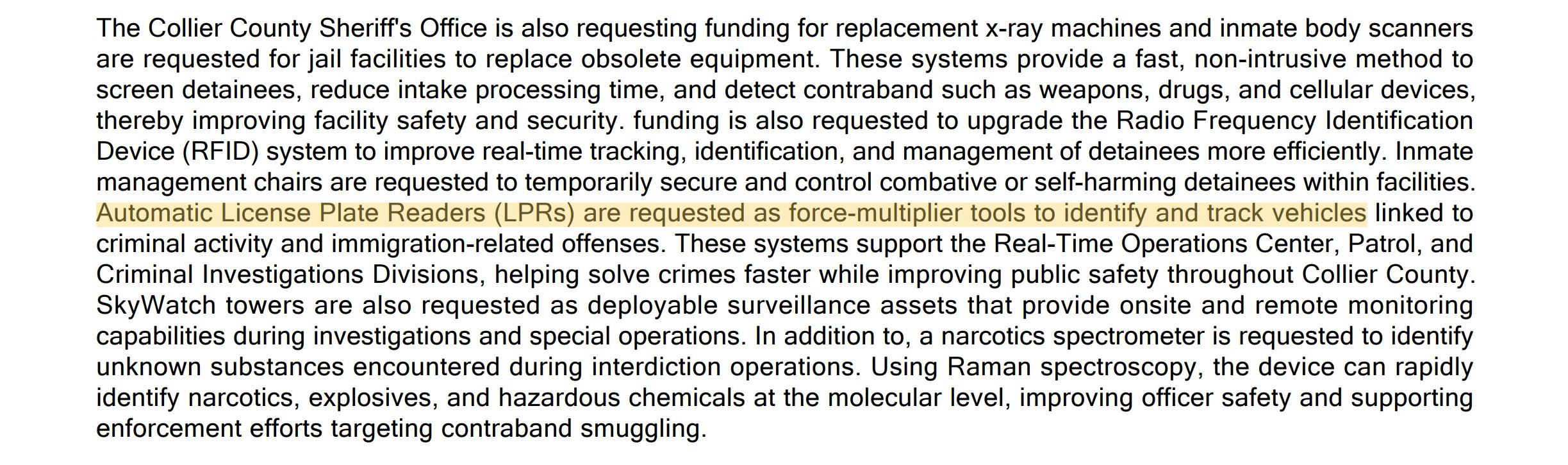 ⇈ Collier County Sheriff's Office ⇈ (pg. 43)
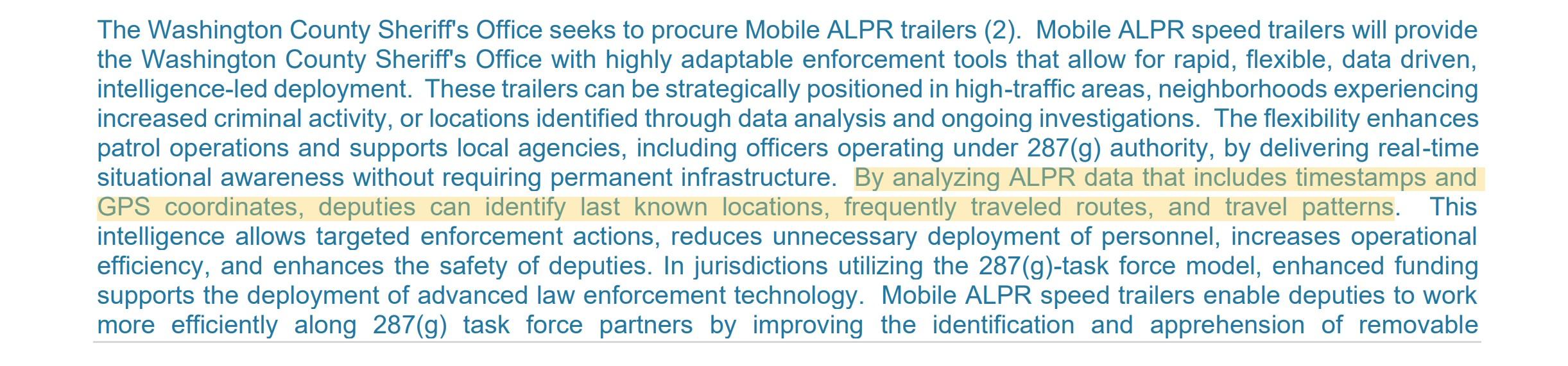 ⇈ Washington County Sheriff's Office ⇈ (pg. 81)
 ⇈ Palm Beach County Sheriff's Office ⇈ (pg. 96)
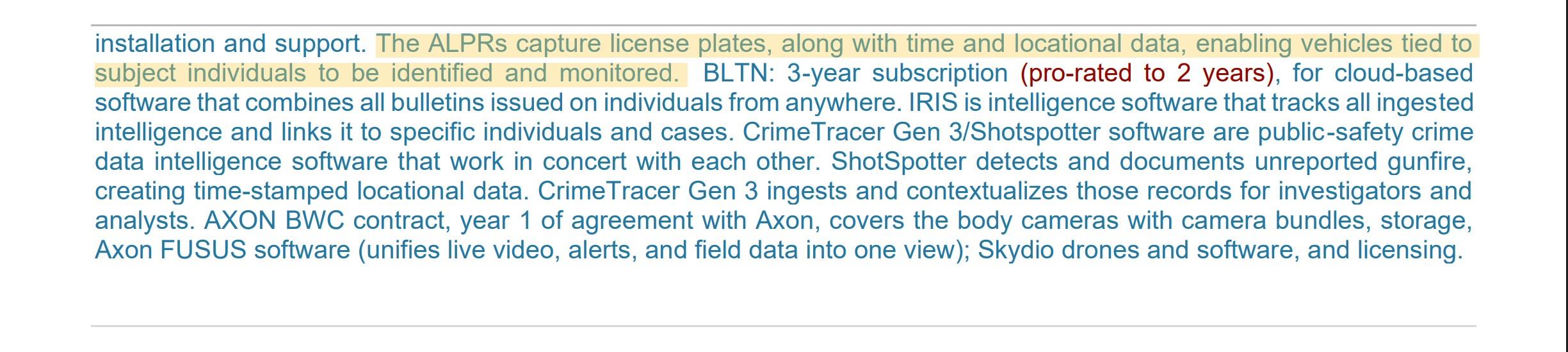 ⇈ Alachua County Sheriff's Office ⇈ (pg. 119)
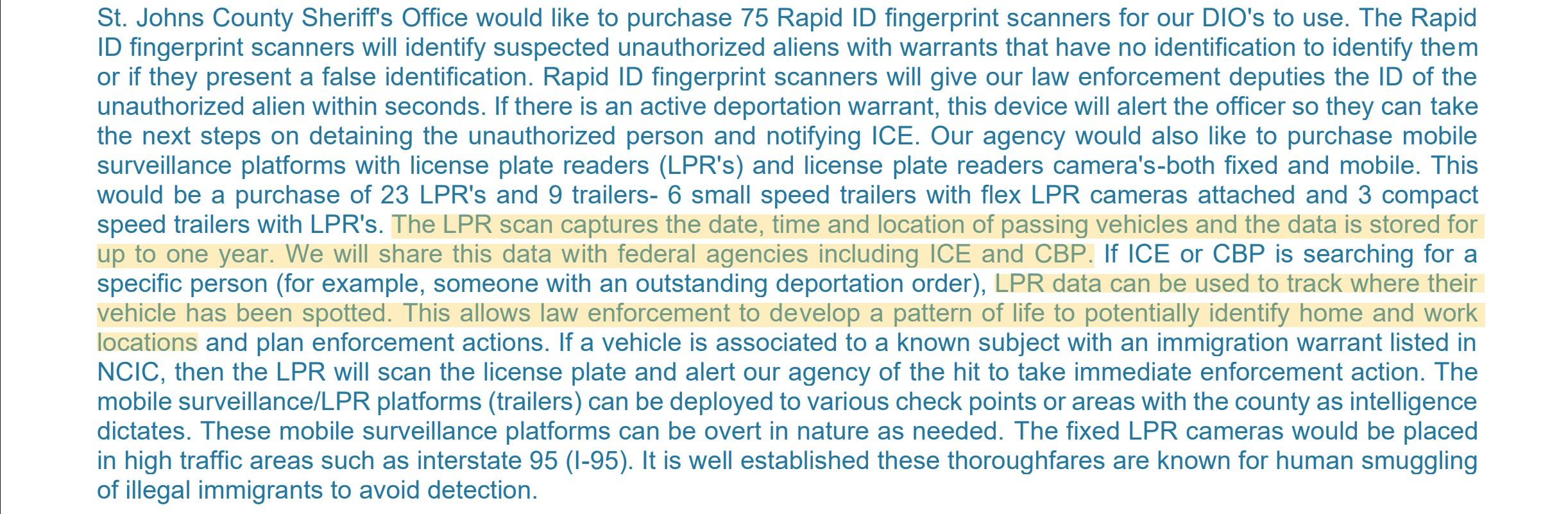 ⇈ St. John's County Sheriff's Office ⇈ (pg. 121)
 ⇈ Hernando County Sheriff's Office ⇈ (pg. 127)
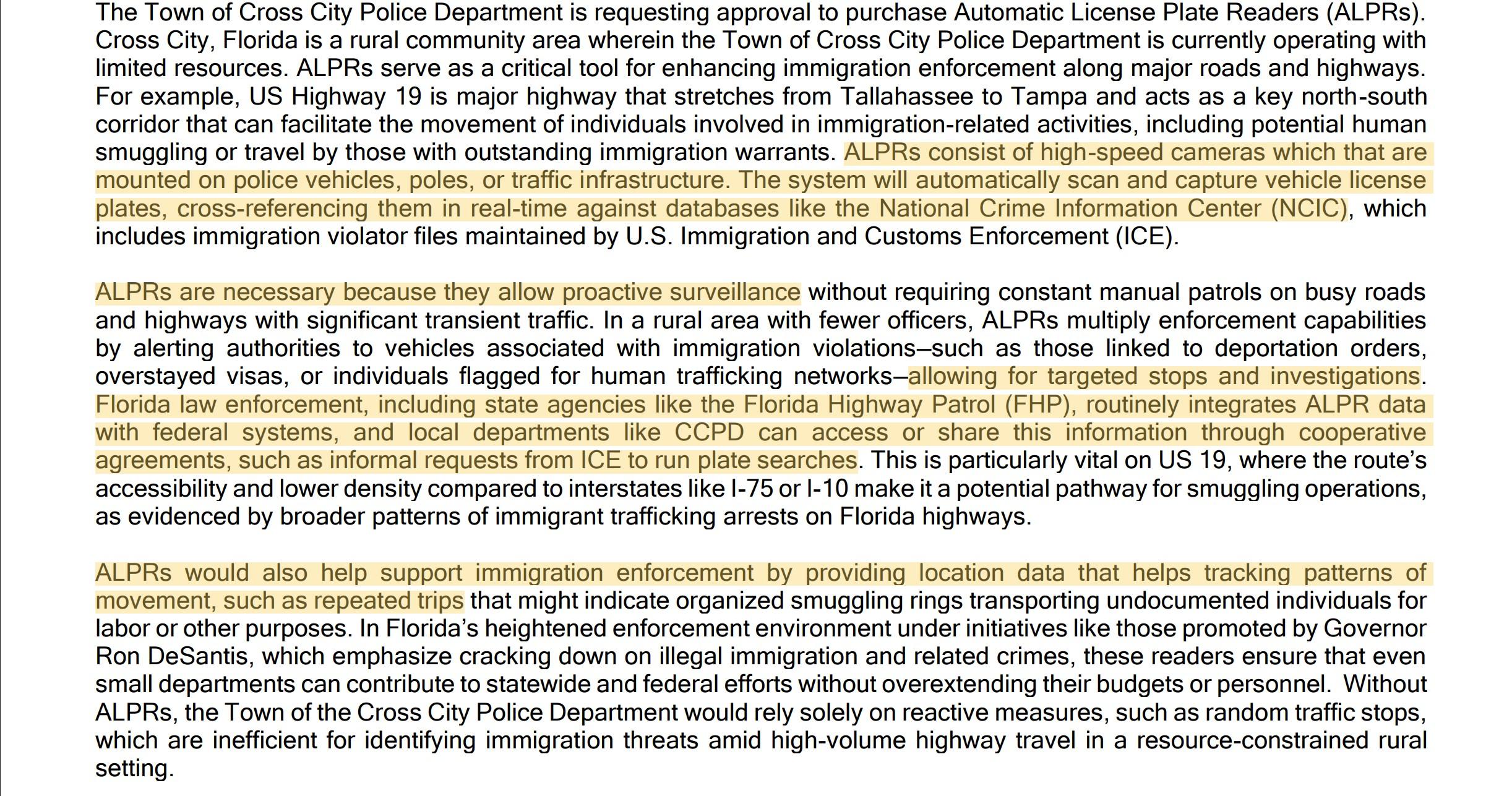
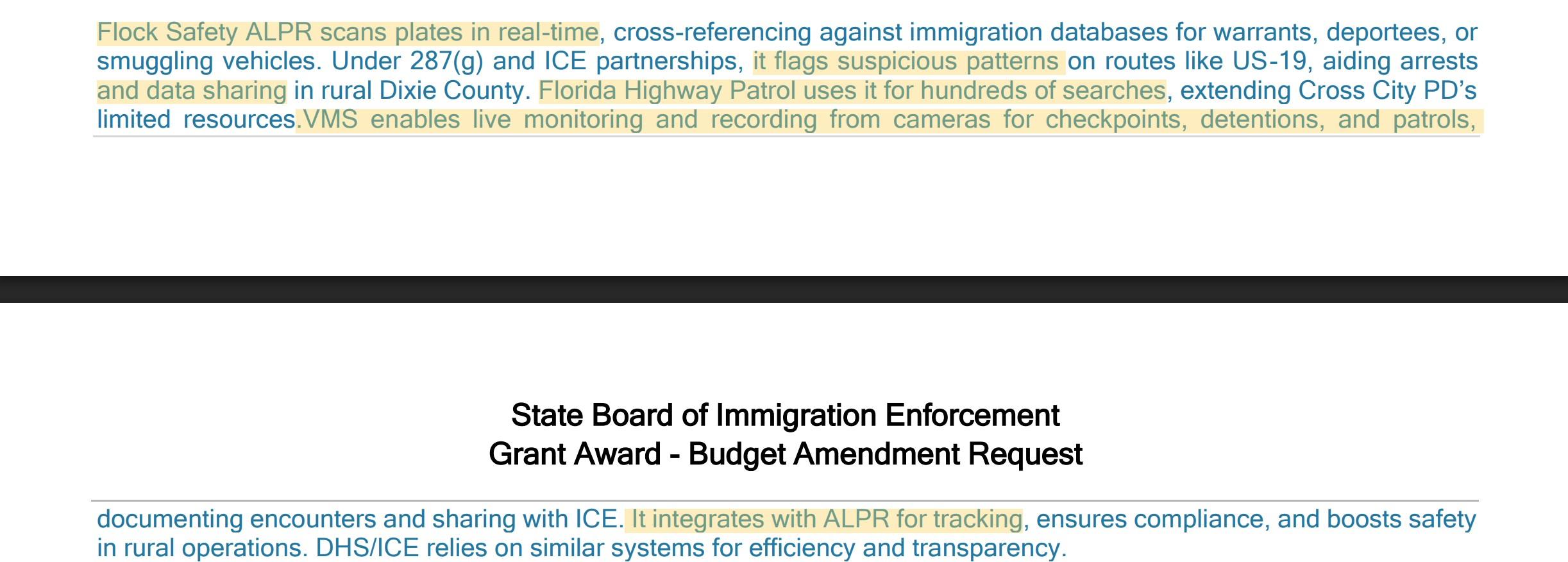 ⇈ The Town of Cross City Police Department, Dixie County ⇈ (pgs. 141-142)
 ⇈ Brevard County Sheriff's Office ⇈ (pg. 152)
 ⇈ Osceola County Sheriff's Office ⇈ (pg. 174)
Important Note: Just because the above quotes reference immigrants,
illegal aliensundocumented persons, criminals, etc., doesn't mean they won't also track YOU. These cameras track and store ALL license plate data, regardless of whether you actually committed a crime. Your information is still accessible, still searchable, and LEO can still make a "pattern of your life."URGENT READ: The heroes at WIRED.com reconstructed Flock's next-generation AI system, already in use by some police, to confirm these devices go much further than tracking license plates. Published on August 19, 2026 the article confirms:
- The test code describes 45 tools at the AI’s disposal, giving it access to plate scans and camera metadata, arrest records, case files, dispatch logs, ballistics results, and commercial databases that contain Social Security numbers, dates of birth, phone numbers, email addresses, relatives and associates.
- An officer no longer needs a plate, a name, or a crime to begin. They supply a place, a stretch of time, and a pattern of behavior, and the system is designed to hand back the people who fit.
- A “workup,” in Flock's terminology, is a one-command background check. It starts with a name and a date of birth and returns what the department's records and commercial data hold: vehicles, prior listings as a suspect, and, on a second screen, relatives, phone numbers, and online accounts.
- Nineteen of the test prompts describe hunting for patterns rather than looking up a record. Fourteen call for no plate, no name, and no description. The officer simply supplies a location, a window of time, and a behavior.
- One example, for instance, takes a single plate and asks the system to plot the journeys of that car and its “top 3 associates.” [...] An officer supplies one vehicle and the software finds up to 20.
- Before an officer runs a search, the software can ask for a justification. The code shows that by default an officer has to type a reason for the search; however, the form appears to place no requirements on what that reason says or how long it must be. If a department also requires a case number, the form checks only that it contains at least three characters.
- Flock's software chains vehicle searches to queries against police records that sort people by sex, race, ethnicity, height, weight, build, scars, marks, and tattoos. One prompt searches by description alone, asking for records matching “male, ~6ft, black hoodie, forearm tattoo” near a location. The tool allows an officer to bound those criteria by selecting a radius or drawing arbitrary shapes on a map.
- Flock leaves most of the rules to its customers. Agency leaders decide who gets credentials, whether to share their camera data across city and state lines, and whether to switch on the settings the company offers to deter abuse. The audit tool that scans an agency’s own searches for suspicious patterns arrived in April 2026 as an option departments can enable. Journalists found any departments did little to monitor the searches themselves.
⚠︎ WARNING ⚠︎ Continued deployment of these AI powered systems is bad for liberty, justice, and freedom. Predictive policing puts everyone--but especially people of color--in DANGER. Experts are even beginning to align this aggressive deployment of AI by Flock as similar to the mass surveillance deployed in China. America survived 250 years without this garbage, and we can do it again with your help. GET INVOLVED. FIGHT BACK.